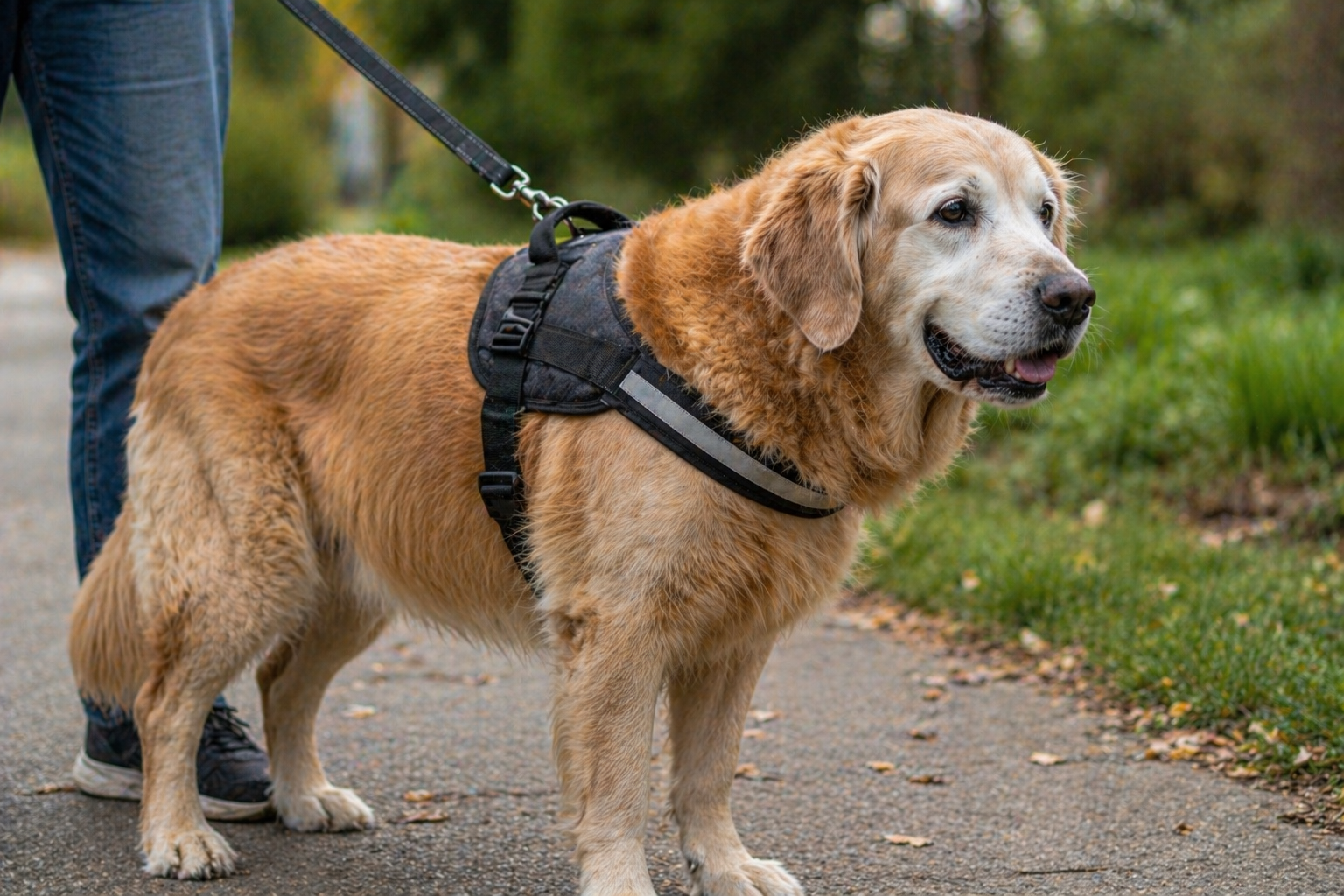
The best senior dog harness is one of those things most owners buy too late. The dog starts struggling to get up, slips on the floor a few times, hesitates at the stairs. Most owners wait and see. By the time they actually do something about it, the dog has been compensating for weeks, putting extra strain on muscles and joints that are already under pressure.
I made the same mistake. When my own dog started showing those signs, I did almost nothing. That is a decision I would make differently now. A good harness does not fix the underlying problem, but it reduces the daily physical load on an aging body and gives the dog a safer, more supported way to move through its day.
The right harness depends on what your dog actually needs. Rear leg weakness requires different support than general instability. A large breed needs different construction than a medium-sized dog. This guide covers six of the best senior dog harness options across different mobility situations so you can match the product to your dog’s specific needs.
This post contains affiliate links. If you buy through these links, I may earn a small commission at no extra cost to you. As an Amazon Associate, I earn from qualifying purchases.
Table of Contents
Quick Picks
Best overall: PetSafe CareLift Full Body Support Harness , Front and rear support in one adjustable system. Padded neoprene, ergonomic handles, easy to put on. The most practical all-round choice for most senior dogs needing daily lift assistance.
Best for active seniors: Ruffwear Web Master Harness , Built for working dogs but adopted widely for senior dogs still walking and hiking. Five adjustment points, reinforced lift handle, breathable foam chassis. The most durable option on this list.
Best premium: Help ‘Em Up Full Body Harness , The vet-recommended gold standard for serious mobility issues. Patented hip lift system supports the pelvis rather than the abdomen. Designed for all-day wear. Worth the price for dogs with advanced arthritis, hip dysplasia, or degenerative myelopathy.
Best budget: LOOBANI Dog Sling , Simple rear support sling at a fraction of the price of full-body options. Soft fleece lining, multiple sizes, machine washable. The most practical starting point for dogs whose primary issue is hind leg weakness.
Best for large dogs: OneTigris Dog Lift Harness , Built specifically for large breeds. Reinforced stitching, stainless steel hardware, three grab handles for multi-angle control. Anti-chafing sleeves prevent skin irritation during extended wear.
Best versatile: Doggie Stylz Multi-Function Lifting Harness, Configurable for front-only, rear-only, or full-body support. One harness that covers multiple scenarios, useful for dogs whose needs change over time or owners who want flexibility without buying multiple products.
Quick decision guide:
- Best all-around for most senior dogs → PetSafe CareLift
- Dog needs help with rear legs only → LOOBANI Dog Sling
- Dog is still active but needs stability → Ruffwear Web Master
- Want the best money can buy → Help ‘Em Up
- Large breed with serious mobility issues → OneTigris
- Want one harness that does everything → Doggie Stylz
Why Senior Dogs Need a Support Harness
A support harness addresses a specific problem that becomes increasingly common from age seven onward: the gap between what a dog wants to do and what its body can safely manage.
Muscle mass declines with age through sarcopenia. Joint cartilage thins. Conditions like arthritis, hip dysplasia, and degenerative myelopathy become more common. What was effortless at three, standing up from a rest, climbing stairs, getting into the car, becomes a genuine physical challenge at ten. A dog that slips on a hard floor and cannot recover cleanly is not being dramatic. It is experiencing the physical reality of reduced strength and coordination.
A support harness reduces the load on painful joints by distributing the dog’s weight across a broader surface area. It gives the owner a safe way to assist with lifting without straining their own back or grabbing the dog awkwardly by the scruff or collar. And it gives the dog a physical anchor, a sense of support, that reduces the anxiety many senior dogs develop around movement as their confidence in their own body decreases.
The clearest signs that a senior dog would benefit from a harness are struggling to stand after lying down, slipping on smooth surfaces, hesitating at stairs or refusing them entirely, difficulty getting in and out of the car, hind legs wobbling or giving way on walks, and visible stiffness or pain during movement. Most owners wait too long when they see these signs. The harness is most useful when introduced before the situation becomes serious, not after.
For a more complete focused on Support check out this article Best Support Harness For Senior Dogs (Best of 2026)
What to Look for in the Best Senior Dog Harness
Type of support. Rear support harnesses help dogs with weak hind legs. Front support harnesses help dogs with shoulder or neck issues. Full-body harnesses support both ends simultaneously, best for dogs with widespread mobility issues. If you are still deciding between a harness and a simpler sling specifically, our guide on dog harness versus dog sling covers when each format actually fits better.”
Padding and material. Senior dogs have thinner, more sensitive skin than younger dogs. Neoprene or fleece-lined padding prevents pressure sores and chafing during daily wear. Bare nylon webbing against a senior dog’s skin causes irritation faster than most owners expect.
Handle placement and strength. The handle is the most important functional element of a support harness. It needs to be positioned over the dog’s centre of gravity for the support type it provides, and it needs to be reinforced enough to handle repeated lifting without breaking down. A handle that shifts position or fails under load is a safety risk.
Ease of putting on and taking off. Arthritic dogs have limited flexibility and limited patience. A harness that requires the dog to lift each leg repeatedly or contort into a position is going to make the process stressful for both dog and owner. Step-in designs and vest-style approaches are generally easier than complex strap systems for daily use.
Adjustability. Senior dogs change shape as they age through muscle loss, weight changes, and postural shifts. An adjustable harness maintains a proper fit as those changes happen. A fixed-size harness that fitted perfectly at purchase may become inadequate within months. For a deeper dive How to Fit a Dog Support Harness (Step-by-Step)
Washability. Senior dogs have accidents more often than younger dogs. A machine-washable harness is a practical necessity, not a nice-to-have.
The 6 Best Senior Dog Harnesses
1. Best Overall: PetSafe CareLift Full Body Support Harness
The PetSafe CareLift is the most consistently recommended senior dog harness across veterinary and owner communities, and the reasoning is practical. It provides both front and rear support in one adjustable system, with sections that can be used independently or together depending on the dog’s specific needs at any given time. That flexibility makes it the most useful starting point for owners who are not yet sure exactly what their dog needs or whose dog’s needs are likely to change.
The padded neoprene design is gentle on sensitive senior skin. The handles are positioned ergonomically to reduce strain on the owner’s back during assisted lifting, which matters when the harness is used multiple times a day. It is straightforward to put on without requiring the dog to lift its legs repeatedly, and it comes in a range of sizes covering most breeds.
Best for: Most senior dogs needing daily front and rear lift assistance
Who should not buy this: Dogs that only need minimal walking support and are still largely mobile. The Ruffwear Web Master is a better fit for active dogs that just need stability on difficult terrain.
2. Best for Active Seniors: Ruffwear Web Master Harness
The Ruffwear Web Master was originally designed for working and adventure dogs, but it has become one of the most widely used harnesses for senior dogs that are still active but need a degree of physical support. The distinction matters: this is not a dedicated mobility harness for dogs with serious weakness. It is the best option for dogs that still walk, hike, and move reasonably well but need a reliable handle and a secure, non-restrictive fit.
Five points of adjustment allow for a precise fit across a wide range of body shapes. The reinforced lift handle is built to handle repeated use without degrading. The perforated foam chassis improves breathability for longer wear, which is relevant for dogs wearing the harness during extended outdoor activity. Reflective trim adds visibility for early morning and evening walks.
Best for: Active senior dogs that need lift assistance on walks, stairs, or outdoor activities
Who should not buy this: Dogs with serious rear leg weakness or significant mobility limitations. They need a dedicated rear support harness or full-body system like the PetSafe CareLift or Help Em Up.
3. Best Premium: Help Em Up Full Body Harness
The Help Em Up harness is the gold standard in senior dog mobility support and the product most owners with seriously affected dogs wish they had bought first rather than working through cheaper options before arriving at it. The patented hip lift system supports the dog’s pelvis rather than the abdomen, which is the critical difference. Most cheaper harnesses lift from the abdomen, which places pressure on the bladder and internal organs during repeated use. The Help Em Up lifts from the pelvis, aligning with the skeletal structure that actually needs support.
Ten adjustment points allow for a genuinely custom fit. The harness is designed for all-day wear, which makes it practical for dogs that need ongoing support throughout the day rather than just during walks. It is used in veterinary rehabilitation clinics and is the harness most commonly recommended by physiotherapists working with dogs recovering from surgery or managing degenerative conditions.
Best for: Dogs with serious mobility challenges including arthritis, hip dysplasia, degenerative myelopathy, and post-surgery recovery.
Who should not buy this: Dogs with minimal mobility issues where the PetSafe CareLift or Ruffwear Web Master provides sufficient support at a meaningfully lower price.
4. Best Budget: LOOBANI Dog Sling
The LOOBANI sling demonstrates that effective rear support does not require a significant investment. It is a simple rear-support design made from durable nylon with a soft fleece lining that wraps under the dog’s abdomen and provides immediate lift assistance for hind legs. It works exactly as described, which is why it has accumulated thousands of consistent positive reviews.
For owners whose dog primarily struggles with rear leg weakness and who want an affordable starting point before committing to a more expensive full-body system, this is the most practical first option. It is available in multiple sizes, easy to put on, easy to clean, and comfortable enough for daily use.
Best for: Senior dogs with rear leg weakness where budget is a primary consideration.
Who should not buy this: Dogs that need simultaneous front and rear support. The PetSafe CareLift covers both ends and is worth the additional cost for dogs with more widespread mobility issues.
5. Best for Large Dogs: OneTigris Dog Lift Harness
Large senior dogs present a specific challenge that most standard harnesses are not built to handle reliably. They are heavy, and the repeated stress of lifting a 35 or 40 kilogram dog multiple times a day puts real strain on stitching, hardware, and handle attachments that cheaper designs cannot sustain. The OneTigris Dog Lift Harness is built specifically for large breeds, with reinforced stitching throughout, stainless steel D-rings, and three grab handles that give the owner control from multiple positions.
The 360-degree support design distributes weight evenly across the dog’s body, reducing the pressure concentration that occurs with simpler sling designs. Anti-chafing sleeves on the rear leg straps prevent the skin irritation that becomes increasingly likely with the thinner coat and reduced skin elasticity common in older large-breed dogs.
Best for: Large and giant breed senior dogs with serious mobility challenges.
Who should not buy this: Small and medium breed dogs. The PetSafe CareLift or LOOBANI is more appropriate and easier to manage at smaller sizes.
6. Best Versatile: Doggie Stylz Multi-Function Lifting Harness
The Doggie Stylz harness is the most adaptable option on this list. It can be configured for front-only support, rear-only support, or full-body support in one product. That flexibility makes it practical for owners whose dog’s needs are evolving, dogs that sometimes need full support and sometimes only partial assistance, or owners who want one harness that covers multiple scenarios without buying separate products for each.
The vest-style design is generally easier to put on than strap-based harnesses, which is relevant for owners dealing with an arthritic dog that resists the fitting process. Sizing is specific to this design, so accurate measurement before purchasing is essential.
Best for: Owners who want one adaptable harness for changing or variable support needs.
Who should not buy this: Dogs with serious and consistent full-body mobility challenges. The Help Em Up or OneTigris provides more robust support for those cases.
Comparison Table
| Product | Support Type | Best For | Key Feature | Price |
|---|---|---|---|---|
| PetSafe CareLift | Front + Rear | Most senior dogs | Neoprene padding, ergonomic handles | $$$ |
| Ruffwear Web Master | Lift assist | Active senior dogs | 5-point adjustment, ultra-durable | $$$ |
| Help ‘Em Up | Full body | Serious mobility issues | Patented hip lift, vet-recommended | $$$$ |
| LOOBANI Dog Sling | Rear only | Budget buyers | Simple, effective, affordable | $ |
| OneTigris | Full body | Large breeds | 3 handles, stainless hardware | $$$ |
| Doggie Stylz | Front/Rear/Full | Versatility | 3 configurations in 1 harness | $$ |
How to Measure Your Senior Dog for a Harness
Getting the right size is critical. A harness that is too tight causes pain and restricts movement. One that is too loose shifts position during use and provides no reliable support when it is needed most.
Measure three points before ordering. First, chest girth: measure around the widest part of the chest, just behind the front legs. This is the most important measurement for fit. Second, neck circumference: measure around the base of the neck where a collar sits. Third, body weight: most harnesses specify weight ranges that serve as a secondary guide alongside girth measurements.
Always check the specific sizing chart for the brand you are ordering from, because sizing varies between manufacturers. When in doubt, size up. Most harnesses are easier to tighten than to loosen, and a slightly larger fit is easier to adjust than one that is too small.
A Harness Supports the Body. Supplements Support the Joints.
A harness reduces the physical load on aging joints during movement. What it cannot do is address what is happening inside those joints. The cartilage that has thinned, the inflammation that makes every step harder, the muscle weakness that makes getting up a struggle. That is where the right supplements make a difference alongside the physical support a harness provides.
Glucosamine and chondroitin slow cartilage deterioration and support joint lubrication. Omega-3 fatty acids from fish oil reduce the systemic inflammation that drives stiffness and pain. MSM supports connective tissue. These are not marketing claims. They are the compounds with the most consistent evidence behind them in veterinary joint health research.
A senior dog using a harness daily is a dog whose joints are already under significant pressure. Combining physical support with targeted nutritional support addresses the problem from both directions. The harness manages the symptoms. The supplements work on the underlying biology.
For a full breakdown of which supplements are worth adding for your dog’s specific situation, the joint supplements for senior dogs covers the evidence behind every major category and the products that deliver the right doses.
FAQ
What type of harness is best for a dog with hip dysplasia?
A full-body harness that lifts from the pelvis rather than the abdomen is best for dogs with hip dysplasia. The Help Em Up and PetSafe CareLift both provide this type of support. Lifting from the abdomen places pressure on sensitive structures near the painful joint, which is why the hip lift mechanism in the Help Em Up is specifically relevant for hip dysplasia cases.
Can a senior dog wear a harness all day?
Some harnesses including the Help Em Up are designed for all-day wear. Most standard harnesses should be removed during rest periods to prevent pressure sores and skin irritation from prolonged contact. Always check the manufacturer’s guidance for the specific product and monitor the skin under the harness straps regularly for signs of irritation.
What is the difference between a support harness and a regular walking harness?
A regular walking harness is designed for leash attachment and basic control during walks. A support harness is designed to assist with lifting and stabilising the dog physically. The key differences are the presence of reinforced handles for lifting, padding designed for extended wear rather than just walking, and construction that can withstand the repeated mechanical stress of assisted lifting.
At what age should I consider a support harness for my senior dog?
The trigger is physical signs rather than age. Struggling to stand after lying down, slipping on smooth floors, hesitating at stairs, difficulty getting into the car, or hind legs giving way during walks all indicate that a harness would be beneficial. Most owners wait too long when they see these signs. Introducing a harness when the signs first appear produces better outcomes than waiting until the dog is in significant difficulty.
Can a harness help a dog with degenerative myelopathy?
Yes. A rear-support harness or full-body harness is a standard management tool for dogs with degenerative myelopathy as the condition progresses. The Help Em Up is particularly well-regarded for DM dogs because the patented hip lift design supports the hindquarters without the abdomen pressure that cheaper slings create. For more on mobility support options for dogs with joint and neurological conditions.
How do I get my dog used to wearing a harness?
Introduce the harness gradually. Let the dog investigate it before putting it on. Start with short wearing periods indoors in a calm environment before using it for actual lift assistance. Pair the process with positive reinforcement. Senior dogs that resist the harness initially often accept it within a few days once they associate it with support rather than restraint. For dogs with significant anxiety around handling, a gradual desensitisation approach over one to two weeks produces better long-term compliance than forcing the issue.
Final Thoughts
The best senior dog harness depends on what your dog actually needs. For most aging dogs, the PetSafe CareLift is the strongest all-round starting point. For dogs with serious mobility challenges including hip dysplasia or degenerative myelopathy, the Help Em Up is worth the investment. For dogs that are still largely active, the Ruffwear Web Master provides durability and reliability that cheaper options do not match. For owners managing a large breed, the OneTigris provides the structural integrity that larger dogs require.
The common mistake is waiting too long. The signs are usually visible weeks or months before owners act on them. A harness introduced early supports the dog during that window and reduces the cumulative physical stress that accelerates decline. It is a practical intervention, not a last resort.
A harness is rarely the only change a senior dog needs. For the bed, ramp, and daily gadgets that work alongside it, see this overview of what actually helps aging dogs at home.
Sources
- https://www.akc.org/expert-advice/health/signs-of-pain-in-dogs/
- https://www.petmd.com/dog/conditions/musculoskeletal/c_dg_degenerative_myelopathy
- https://www.akcchf.org/canine-health/your-dogs-health/caring-for-your-dog/hip-dysplasia.html
- https://www.ncbi.nlm.nih.gov/pmc/articles/PMC6063540/
- https://helpemup.com/
- https://ruffwear.com/products/web-master-harness
- https://www.petsafe.net/carelift


Pingback: Best Mobility Aids for Senior Dogs – 2026 Guide
Pingback: Soothing Tips for Dogs in Pain: What Actually Helps at Home
Pingback: Senior Dog Mobility Aids: What They Are and When Your Dog Needs Them
Pingback: How to Fit a Dog Support Harness (Step-by-Step) - seniordog-care
Pingback: Why Good Support Harnesses Help Aging Dogs - seniordog-care
Pingback: Dog Harness vs Dog Sling: Which Fits Your Senior Dog? - seniordog-care
Pingback: Best Gadgets for Senior Dogs: The Complete Guide
Pingback: How to Recognize Pain in Senior Dogs - seniordog-care