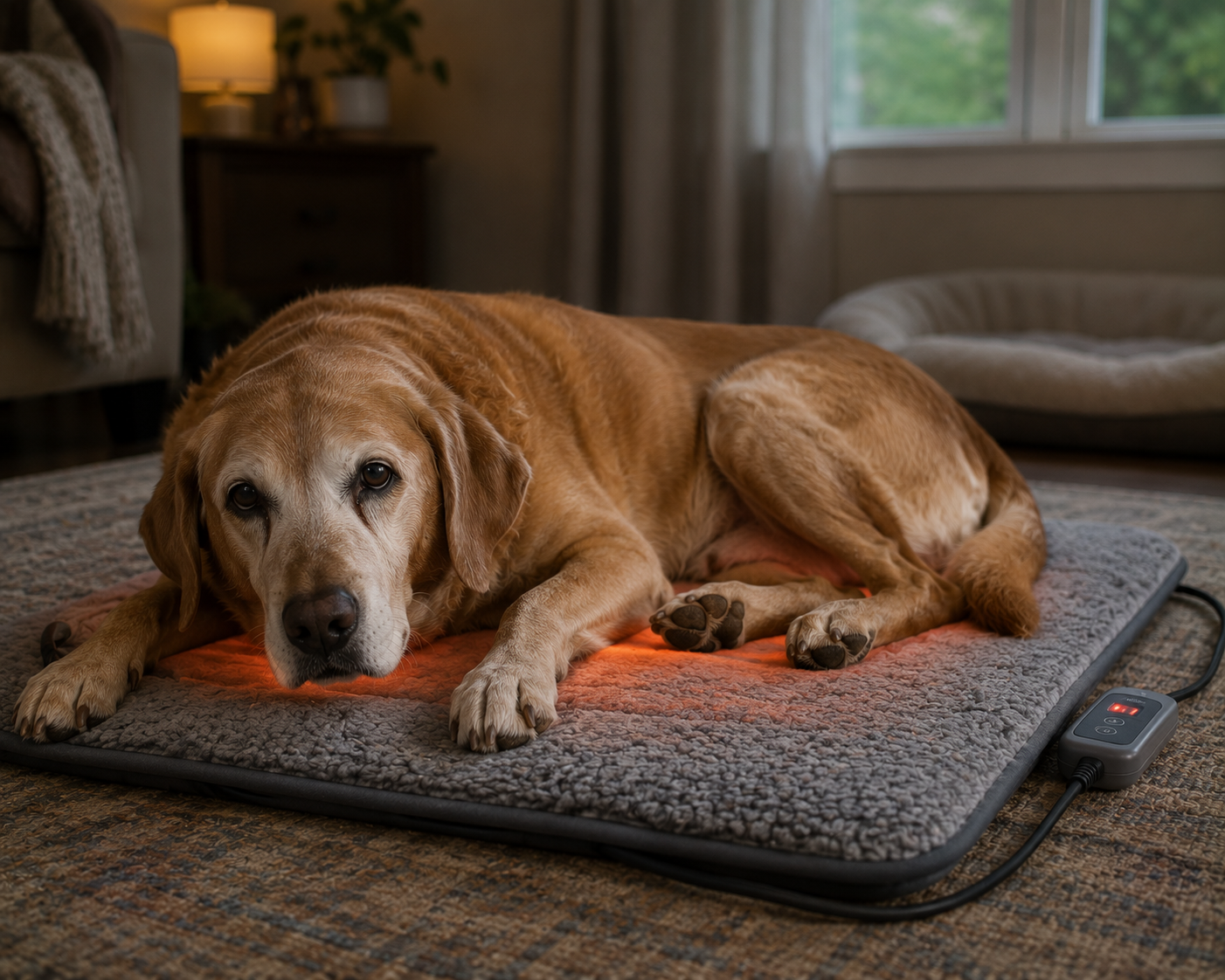
Are heating pads good for Senior dogs with arthritis? The short answer is yes, but only when used correctly. Heat therapy is one of the most accessible and effective tools for managing arthritis pain in senior dogs, yet it is also one of the most commonly misused. A heating pad for senior dogs with arthritis can ease stiffness, improve circulation, and make a real difference to daily comfort. Used the wrong way, it can cause burns or make inflammation worse.
This article explains how heat therapy for dogs actually works, when it helps and when it does not, and how to use a heating pad safely so your dog gets the benefit without the risk.
Table of Contents
How Heat Therapy for Senior Dogs Works
Before answering whether heating pads are good for senior dogs with arthritis, it helps to understand what heat actually does to the body.
When heat is applied to a stiff or painful joint, several things happen. Blood vessels in the area dilate, which increases blood flow and brings more oxygen and nutrients to the tissue. Muscle tension around the joint decreases, which reduces the stiffness that makes movement painful. Nerve sensitivity to pain also lowers temporarily, which is why warmth feels immediately soothing on an aching joint.
For a senior dog with arthritis, these effects are directly useful. Arthritis causes the cartilage inside a joint to break down over time, leading to bone-on-bone friction, inflammation, and chronic pain. The muscles and connective tissue around an arthritic joint often tighten up as a protective response, which adds a second layer of stiffness on top of the joint damage itself. Dog arthritis heat therapy addresses that second layer effectively. It does not repair the joint, but it makes living with the joint significantly more comfortable.
This is why heating pads for senior dogs with arthritis tend to be most useful in the mornings, when stiffness from a night of lying still is at its worst, or before activity, to loosen up a dog that struggles to get moving.
When Heating Pads Help and When They Do Not
Heat therapy for dogs works best for chronic stiffness and muscle tension. It is less appropriate, and sometimes actively harmful, for acute inflammation.
The distinction matters because arthritis has two states. Chronic arthritis involves persistent joint damage and the background stiffness that comes with it. Acute flare-ups involve active inflammation, where the joint is swollen, hot to the touch, and more painful than usual. Applying a heated dog bed or heating pad during an acute flare adds heat to a joint that is already inflamed, which can increase swelling and make pain worse rather than better.
A simple way to tell the difference: if the joint feels warm or looks swollen, that is a flare-up and heat is the wrong tool. Cold therapy, such as a wrapped ice pack applied for 10 to 15 minutes, is more appropriate in that situation. If the dog is simply stiff and slow to get moving without visible swelling or warmth in the joint, a heating pad for dogs with arthritis is appropriate.
Dog arthritis pain relief at home works best when the right tool is matched to the right situation.

The Most Common Mistakes with Heating Pads for Senior Dogs
Most problems with heating pads for senior dogs with arthritis come down to incorrect use rather than the tool itself. These are the mistakes that matter most.
Using a human heating pad on a dog
Human heating pads are designed to be used by people who can feel when something is too hot and shift position or remove the pad. Dogs cannot reliably communicate discomfort the same way, and many will stay lying on a surface even when it is causing harm. Human heating pads also tend to run hotter than is safe for prolonged contact on a dog. A safe heating pad for dogs is specifically designed with lower maximum temperatures and automatic shut-off features.
Leaving it on too long
Even a dog-specific heating pad should not be left on a dog for extended periods without breaks. Around 15 to 20 minutes per session is appropriate for targeted heat therapy for dogs. Longer sessions increase the risk of contact burns, particularly in dogs with reduced skin sensitivity due to age or nerve damage.
No escape route
A dog lying on a heating pad must always be able to move off it freely. If the pad is inside a crate or positioned in a way that the dog cannot easily leave, there is no way for the dog to self-regulate if it gets too warm. Always set up a heated dog bed or pad so the dog has uncovered space nearby to move to.
Applying it directly to skin
Always place a thin layer of fabric between the heating pad and the dog’s skin or coat. Direct contact increases the risk of burns, especially with older dogs whose skin is thinner and more sensitive.
Using heat on a newly injured joint
If your dog has recently injured a leg or joint, or if you have noticed sudden increased lameness, heat is not appropriate until a vet has assessed the situation. Acute injuries involve inflammation and heat makes inflammation worse. Dog arthritis heat therapy is for chronic, managed conditions, not new injuries.
How to Use a Heating Pad for Senior Dogs with Arthritis Safely
Used correctly, a heating pad for senior dogs with arthritis is a straightforward tool. Here is a simple approach that avoids the most common mistakes.
Choose a pad designed specifically for dogs, with a maximum temperature that does not exceed around 40 to 42 degrees Celsius, and an automatic shut-off. Place a thin towel or blanket over the pad before your dog lies on it. Position it in a spot where the dog can easily move off it onto a cooler surface. Limit sessions to 15 to 20 minutes, particularly when first introducing heat therapy. Watch for signs of discomfort such as restlessness, panting, or repeatedly moving away from the pad.
For senior dogs with arthritis in multiple joints, a heated dog bed designed for senior dogs is often a better option than a targeted pad, since it provides whole-body warmth at a consistent low temperature throughout the night. This suits senior dogs that stiffen up significantly after lying still for long periods.
You can find the options I have assessed for safety and effectiveness in my guide to the best heating pads for dogs with arthritis.
Heat Versus Cold for Senior Dog Arthritis Pain Relief
Owners often ask whether heat or cold is better for senior dog arthritis pain relief. The answer depends on what you are treating.
Heat is better for chronic stiffness, muscle tension, and the general aching that comes with long-term arthritis. It is best used before activity or in the morning when a dog is at its stiffest.
Cold is better for acute inflammation, recent injuries, and post-exercise swelling. A wrapped ice pack applied for 10 to 15 minutes after a walk can reduce swelling in a joint that has been used more than usual.
Many owners of senior dogs with arthritis use both at different times, which is entirely appropriate. The key is matching the tool to what is actually happening in the joint at that moment.
Other Dog Arthritis Treatment at Home Options
A heating pad is one part of a broader approach to managing arthritis in senior dogs at home. Used on its own, it provides temporary comfort. Combined with other approaches, it contributes to a meaningful improvement in daily quality of life. For the fuller picture of joint health and longevity beyond arthritis specifically, my ultimate guide to joint health and longevity covers that ground, and my guide on how to help senior dogs with arthritis at home brings weight management, exercise, and supplements together into one daily routine.
Joint supplements containing glucosamine, chondroitin, and omega-3 fatty acids address the underlying joint health rather than just the symptoms. These take time to show effect but have reasonable evidence behind them for long-term joint support. I cover the most relevant options in my guide to the best supplements for senior dogs.
Weight management matters significantly for arthritic dogs. Every extra kilogram a dog carries increases the load on already-damaged joints. If your dog is overweight, addressing that is one of the most effective dog arthritis treatment at home strategies available.
Gentle, consistent exercise maintains muscle strength around the joints, which reduces the instability that makes arthritis worse. Short, frequent walks on soft surfaces are better than occasional longer ones.
Orthopedic bedding reduces pressure on joints during the hours a dog spends lying down. A dog that sleeps on a hard floor is putting sustained pressure on already-painful joints throughout the night. You can find the options I have assessed in my guide to the best orthopedic dog beds for senior dogs.
For dogs whose mobility is significantly affected, mobility aids such as ramps and support harnesses can reduce the strain of everyday movements. My guide to mobility aids for senior dogs covers the main options.
FAQ
Are heating pads safe for senior dogs with arthritis?
Yes, when used correctly. A safe heating pad for senior dogs should be designed specifically for dogs, kept at a low temperature, used for limited sessions of 15 to 20 minutes, and always allow the dog to move off it freely. Human heating pads are not recommended.
How long should I leave a heating pad on my senior dog?
Around 15 to 20 minutes per session is appropriate for most senior dogs. Longer sessions increase the risk of burns, particularly in older dogs with thinner skin. Always monitor your dog during use.
Can I use a heating pad on a senior dog every day?
Yes, daily use is fine as long as each session is kept to an appropriate length and the pad is used correctly. Many owners use heat therapy for dogs as part of a morning routine before their dog gets moving for the day.
Should I use heat or ice for my senior dog’s arthritis?
Heat is better for chronic stiffness and morning tightness. Cold is better for acute flare-ups where the joint feels warm or looks swollen. Many senoir dogs with arthritis benefit from both at different times depending on what the joint is doing that day.
What temperature should a heating pad be for a senior dog?
A heating pad for senior dogs with arthritis should not exceed around 40 to 42 degrees Celsius. This is warm enough to provide therapeutic benefit without risking burns. Pads designed specifically for dogs typically stay within this range automatically.
Can a heated dog bed replace a heating pad?
A heated dog bed provides consistent low-level warmth throughout the night and is well suited for senior dogs that stiffen up after lying still for long periods. A targeted heating pad is better for focused sessions on a specific joint. Many owners use both for different purposes.
Final Thoughts
Are heating pads good for senior dogs with arthritis? Yes, and they are one of the more practical and affordable tools available for managing chronic joint pain at home. The benefits are real: reduced stiffness, better circulation, lower muscle tension, and a dog that moves more comfortably through its day.
The key is using them correctly. The right temperature, the right session length, an escape route, and a basic understanding of when heat helps versus when it does not make the difference between a tool that works and one that causes harm. A safe heating pad for dogs used as part of a broader approach to dog arthritis pain relief is a genuinely useful addition to senior dog care.
Sources
- https://www.akcchf.org/educational-resources/library/articles/osteoarthritis-in-dogs
- https://www.vet.cornell.edu/departments-centers-and-institutes/riney-canine-health-center/canine-health-topics/arthritis-dogs
- https://www.petmd.com/dog/conditions/musculoskeletal/arthritis-dogs
- https://todaysveterinarypractice.com/pain-management/physical-rehabilitation-the-use-of-heat-and-cold-in-small-animal-rehabilitation
- https://www.merckvetmanual.com/musculoskeletal-system/joint-diseases-of-small-animals/osteoarthritis-in-dogs-and-cats


Pingback: Best Mobility Aids for Senior Dogs – 2026 Guide
Pingback: How to Help Senior Dogs with Arthritis at Home
Pingback: Senior Dog Winter Care: A Complete Guide - seniordog-care