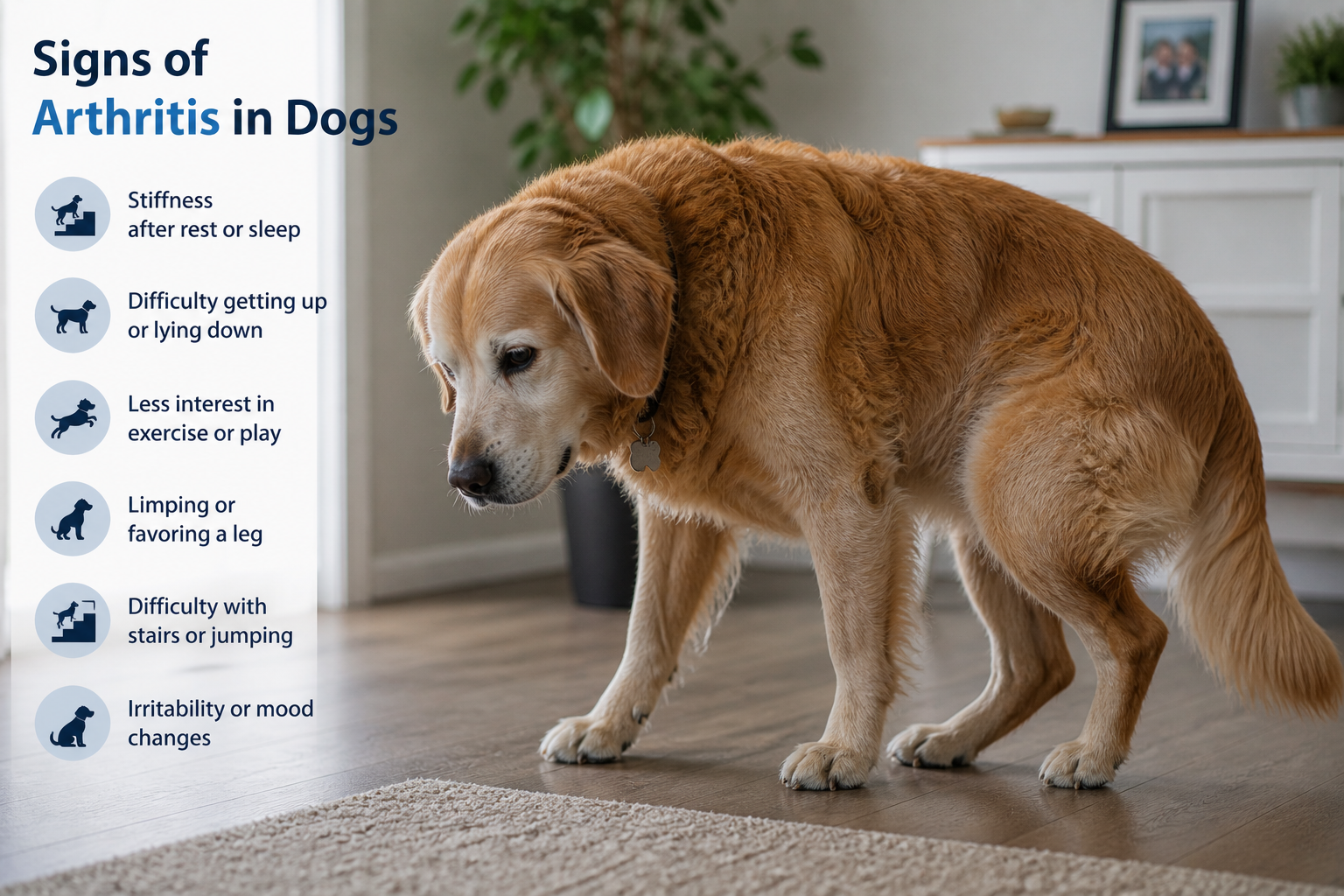
Most owners notice the signs of arthritis in senior dogs gradually. Their dog is a little slower getting up in the morning. A little less enthusiastic about the walk. A little more reluctant to jump in the car.
It is easy to write this off as “just getting older,” but that is not the full picture.
Yes, senior dogs slow down with age, but a lot of what looks like normal ageing is actually arthritis, and arthritis is something you can genuinely do something about. From the inside with the right food and supplements, and from the outside with the right bed, ramp, or harness.
The earlier you recognise it in your senior dog, the more you can do. Here is what to look for.
This post contains affiliate links. If you buy through these links, I may earn a small commission at no extra cost to you. As an Amazon Associate, I earn from qualifying purchases.
Table of Contents
What Is Arthritis in Senior Dogs?
Arthritis, officially called osteoarthritis or degenerative joint disease, is the gradual breakdown of cartilage in your dog’s joints. Cartilage acts as a cushion between bones. When it breaks down, bones start rubbing against each other, causing pain, inflammation, and stiffness.
It becomes significantly more common as dogs enter their senior years. Studies suggest that up to 80% of dogs over age 8 have some degree of arthritis, many of them without their owners realising it.
The reason so many cases go unnoticed in senior dogs specifically is that dogs do not complain the way humans do. They adapt. They move a little less, rest a little more, and quietly work around the pain. By the time most owners notice something is wrong, the arthritis has often been developing for months or years, well within what looked like a normal senior slowdown.
Early Signs of Arthritis in Senior Dogs
These are the signs that often get dismissed as “just ageing” but are actually early indicators of arthritis worth paying attention to in a senior dog.
Slower to get up after lying down. This is usually the first thing owners notice. Your dog takes longer than usual to stand up after resting, especially first thing in the morning. They might look stiff, take a few careful steps before moving normally, or hesitate before committing to standing.
Stiffness that improves during the day. Arthritis stiffness is worst after rest and tends to ease up once your dog has been moving for a while. If your senior dog seems stiff in the morning but moves more freely by the afternoon, that pattern is a classic early arthritis sign, not simply a slow start to the day.
Less enthusiasm for walks or play. A dog that used to pull on the leash and now hangs back. A dog that used to love fetch and now loses interest after a few throws. Reduced enthusiasm for physical activity is often pain avoidance, your dog has learned that moving hurts.
Hesitation at stairs or before jumping. Stairs and jumping put significant force through joints. A senior dog developing arthritis will often pause before climbing stairs, take them more slowly, or stop jumping onto furniture and into the car they used to manage easily.
Lagging behind on walks. If your dog used to keep pace easily and now falls behind, wants to turn back earlier, or sits down during walks, joint pain is a likely cause rather than simple tiredness.
More Obvious Signs of Arthritis in Senior Dogs
As arthritis progresses, the signs become harder to miss.
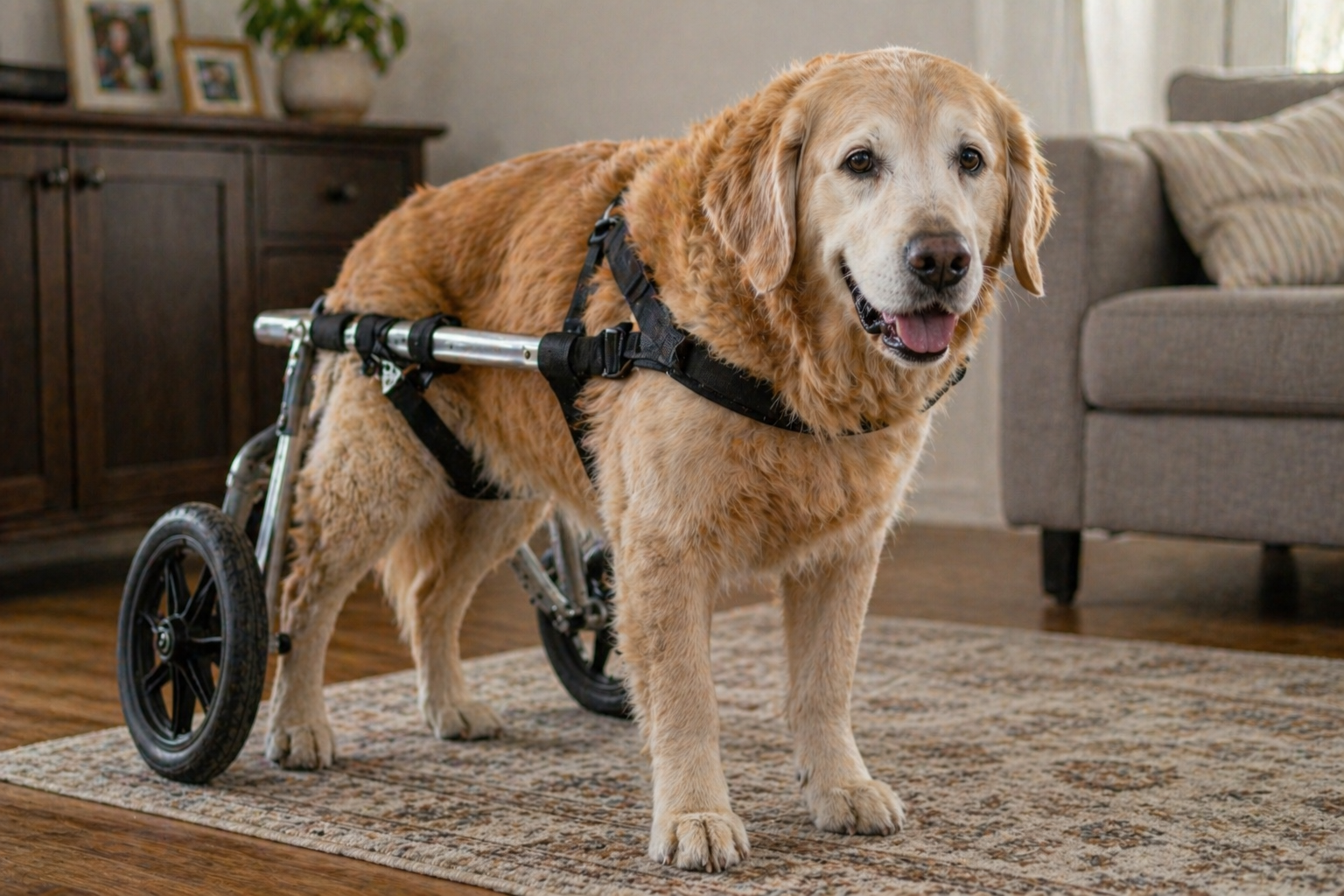
Limping or favouring one leg. Obvious limping, especially after rest or exercise, is a clear indicator of joint pain. Your dog may limp consistently on one leg or alternate depending on which joints are most affected.
Visible pain when touched. Flinching, pulling away, or snapping when you touch certain areas, particularly the hips, shoulders, or spine, indicates localised pain. Some senior dogs that were always relaxed about being handled become reactive once arthritic joints are touched.
Muscle loss in the hindquarters. Dogs with hind leg arthritis naturally use those legs less, which leads to muscle atrophy. If your dog’s back legs look thinner or less defined than they used to, reduced use from pain avoidance is a likely cause.
Licking or chewing joints. Dogs instinctively lick areas that hurt. Persistent licking or chewing at a specific joint, a hip, an elbow, a knee, is often a sign of localised arthritis pain.
Personality changes. A senior dog in chronic pain often becomes quieter, less social, or more irritable. A dog that was previously relaxed about being touched may start growling or snapping. These behavioural changes are usually pain responses, not a change in temperament.
Difficulty with basic movements. Struggling to squat to go to the toilet, difficulty finding a comfortable position to lie down, reluctance to eat from a floor-level bowl, these are signs that movement itself has become painful.
For a deeper dive into recognising pain generally, read our article: How to Recognize Pain in Senior Dogs
Which Senior Dogs Are Most at Risk?
Any senior dog can develop arthritis, but some are more likely to develop it earlier or more severely.
Large and giant breeds. Labrador Retrievers, German Shepherds, Golden Retrievers, Rottweilers, and Great Danes carry more body weight through their joints and are significantly more prone to early arthritis, often showing signs as early as age 5 to 6, before most owners would think to call them senior at all.
Overweight dogs. Extra body weight puts direct additional pressure on joints. An overweight senior dog’s arthritis will progress faster and cause more pain than a dog at a healthy weight with the same underlying joint condition.
Dogs with previous injuries. A leg fracture, cruciate ligament tear, or hip injury earlier in life significantly increases the risk of arthritis in that joint once a dog reaches its senior years.
Certain breeds. Dachshunds and Basset Hounds are prone to spinal arthritis. Bulldogs, Pugs, and other flat-faced breeds often have joint abnormalities that predispose them to early arthritis. Hip dysplasia, common in many large breeds, almost always leads to arthritis over time.
Senior dogs of any breed. The risk increases significantly from age 7 onward regardless of breed or size, which is exactly why this is worth watching for proactively rather than waiting for a dramatic symptom.
“It’s Just Old Age”: Why That Is Not Good Enough
The most common reason arthritis goes unmanaged in senior dogs is this: owners assume slowing down is simply a normal part of ageing and there is nothing to be done about it.
That is not true.
You cannot reverse arthritis, the cartilage damage is permanent. But you can significantly reduce your senior dog’s pain, slow the progression, and improve their quality of life. From the inside with the right food and supplements. From the outside with the right bed, mobility aids, and home setup.
A senior dog with well-managed arthritis lives a meaningfully better life than one whose arthritis is written off as inevitable ageing. The difference between the two is usually just whether the owner knows what to look for and acts on it.
Best Orthopedic Dog Beds for Senior Dogs with Arthritis
What to Do If You Recognise These Signs in Your Senior Dog
1. Talk to your vet. If you are seeing multiple signs from this list, a vet visit is the right first step. Your vet can confirm arthritis through a physical exam and X-rays, assess the severity, and discuss pain management options including medication if appropriate.
2. Support joints from the inside. The right food and supplements make a real difference for arthritic senior dogs. Glucosamine, chondroitin, and omega-3 fatty acids are the most evidence-backed options for supporting joint health and reducing inflammation. For the fuller picture of joint health and longevity beyond arthritis specifically, our ultimate guide to joint health and longevity covers that ground.
→ Read our guide: Best Supplements for Senior Dogs
3. Get the sleep situation right. A senior dog sleeping on a thin, unsupportive bed wakes up stiffer and more painful. A high-density orthopedic memory foam bed distributes weight evenly and reduces overnight joint pressure, often the single most impactful change owners make.
→ Read our guide: Best Orthopedic Dog Beds for Senior Dogs
4. Use heat therapy for morning stiffness. A heating pad designed for dogs reduces the morning stiffness that is often most painful for arthritic senior dogs. Gentle heat increases blood flow to stiff joints and helps your dog start the day more comfortably.
→ Read our guide: Best Heating Pad for Dogs with Arthritis
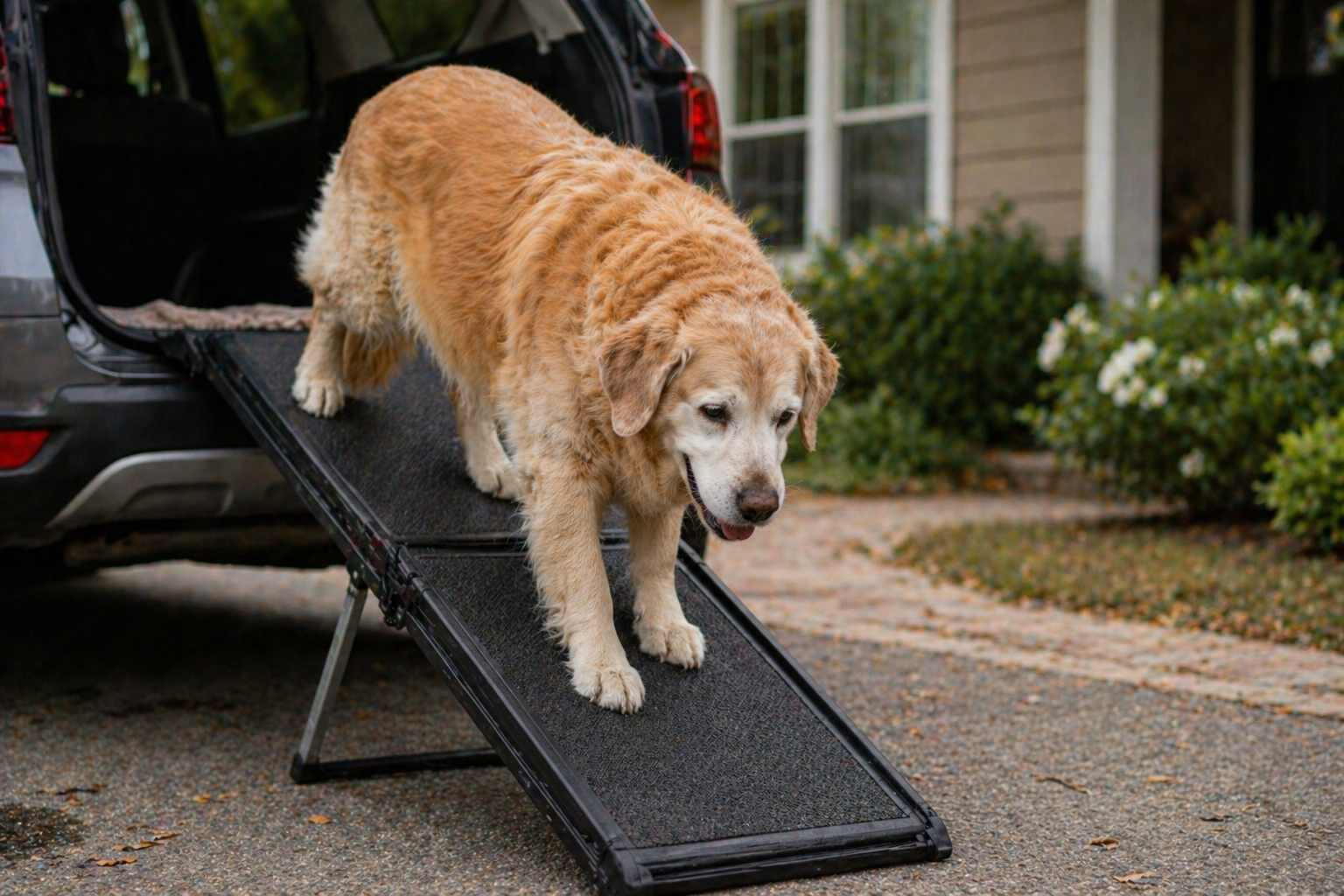
5. Remove daily physical barriers. Stairs, jumping in the car, slippery floors, these are all daily stressors for an arthritic senior dog. A ramp for the car, non-slip rugs, and a support harness for walks reduce the physical demand on painful joints every single day.
→ Read our guide: Best Mobility Aids for Senior Dogs
6. Keep them moving, gently. Rest feels like the answer but too much rest makes arthritis worse. Short, consistent walks on flat surfaces keep joints mobile and muscles active. Twenty minutes twice a day beats one long walk every few days.
→ Read our guide: How to Help a Senior Dog with Arthritis at Home
FAQ
Is arthritis painful for senior dogs?
Yes. Arthritis causes chronic joint pain that ranges from mild discomfort to significant daily pain depending on severity. Because dogs adapt to pain rather than showing it obviously, many arthritic senior dogs are in more discomfort than their owners realise.
Can arthritis be cured?
No. The cartilage damage that causes arthritis is permanent. But arthritis can be very effectively managed, pain reduced, progression slowed, and quality of life significantly improved, with the right combination of medication, supplements, nutrition, and lifestyle adjustments.
How is arthritis diagnosed in a senior dog?
Your vet will typically do a physical examination, feeling for joint thickening, reduced range of motion, and pain responses, combined with X-rays to assess cartilage and bone changes. Blood tests may also be done to rule out other conditions.
At what age should I start watching for arthritis signs?
For large breeds, from age 5 to 6. For medium breeds, from age 7 to 8. For small breeds, from age 8 to 10. Any dog with a previous joint injury should be monitored earlier regardless of size.
Can I give my senior dog human arthritis medication?
Never. Human NSAIDs like ibuprofen and aspirin are toxic to dogs and can cause serious organ damage. Only use medications prescribed or approved by your vet for dogs.
Does every senior dog eventually develop arthritis?
Not every dog, but the majority do to some degree. Genetics, breed, weight history, and past injuries all influence whether and how severely it develops, which is why watching for the early signs matters regardless of how healthy your dog currently seems.
Final Thoughts
Arthritis in a senior dog is not just old age. It is a manageable condition, and the earlier you recognise it, the more you can do about it.
Watch for the early signs. A little stiffness in the morning, some hesitation at the stairs, less enthusiasm on walks. Do not write it off. Act on it.
Your senior dog cannot tell you they are in pain. But the signs are there if you know what to look for.
Sources
- https://www.akc.org/expert-advice/health/arthritis-in-dogs/
- https://www.avma.org/resources-tools/pet-owners/petcare/osteoarthritis-dogs
- https://www.ncbi.nlm.nih.gov/pmc/articles/PMC6063540/
- https://www.vet.cornell.edu/departments-centers-and-institutes/riney-canine-health-center/canine-health-information/arthritis


Pingback: Best Supplements for Senior Dogs: What Actually Works
Pingback: Senior Dog Nutrition 101: The Complete Feeding Guide for Older Dogs
Pingback: Best Mobility Aids for Senior Dogs – 2026 Guide
Pingback: How to Help Senior Dogs with Arthritis at Home (2026 Guide)
Pingback: The Impact of Aging on Dog Joints: Prevention and Support for Senior Dogs
Pingback: How to Recognize Pain in Senior Dogs - seniordog-care