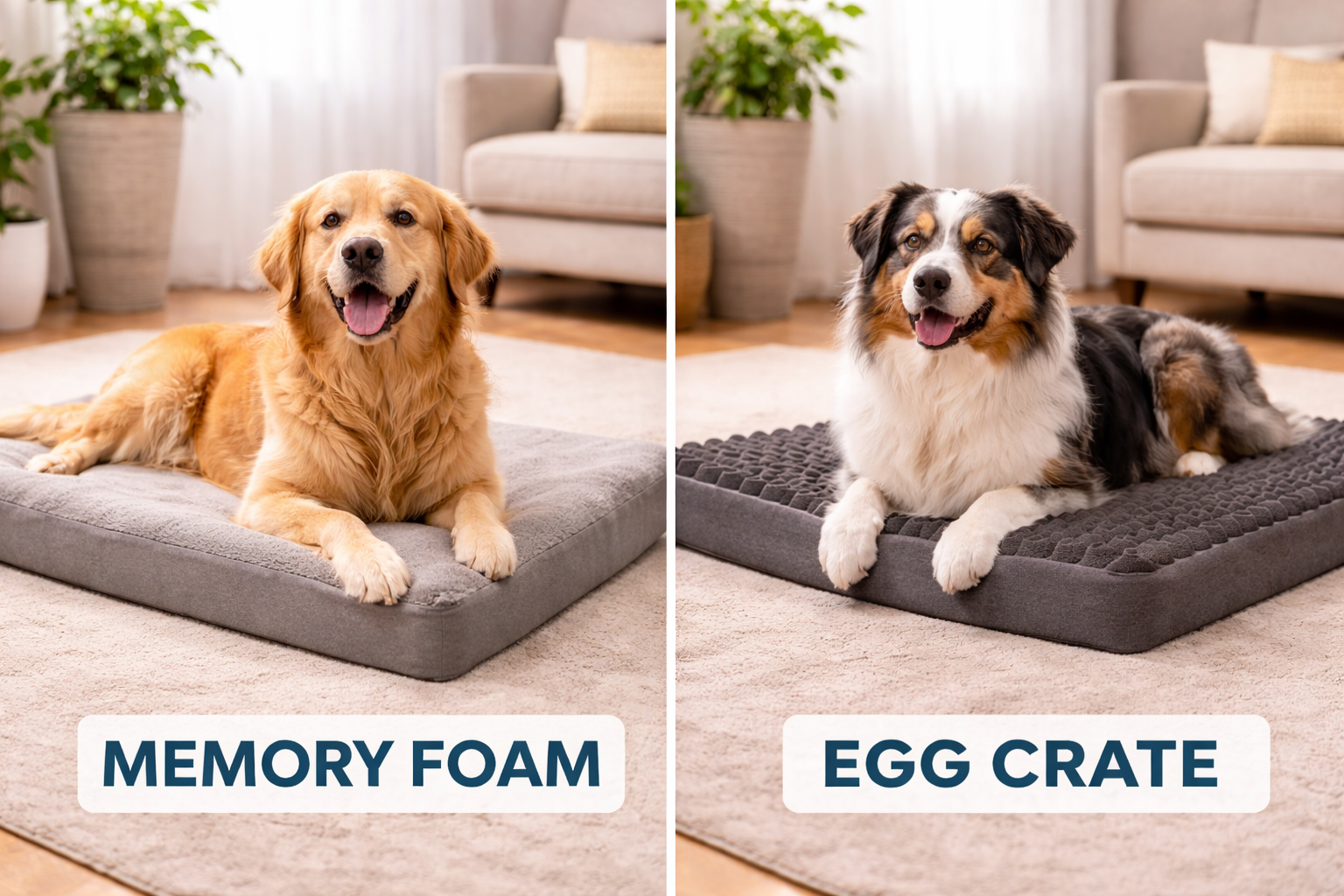
Memory foam versus egg crate is the comparison most owners never actually make before buying a dog bed, and it is exactly the comparison that determines whether a senior dog gets genuine joint support or just the appearance of it. Most people shopping for a bed focus on softness, pressing a hand into the display model and judging comfort from that single gesture. That is the wrong way to evaluate either option, and it is exactly how so many owners end up with a bed that feels fine in the shop and does almost nothing for their dog’s joints within a few weeks of daily use.
The real difference between the two is support, not softness. A bed can feel soft under a hand and still provide almost no meaningful support once a dog’s actual body weight settles onto it night after night. This is precisely where egg crate foam tends to fall short for a senior dog specifically. It improves comfort slightly over a bare floor, but it does not hold its shape under sustained weight the way genuine memory foam does, which matters considerably more for an ageing dog whose joints have less natural cushioning left to compensate for an inadequate surface.
This guide compares both foam types directly for a senior dog’s specific needs, not general marketing claims, and covers which one actually makes sense depending on your dog’s size, weight, and joint condition. For product recommendations across every size and price point, our guide to the best orthopedic dog beds for senior dogs covers the full range. For a small senior dog specifically, our guide to the best orthopedic dog bed for small senior dogs covers that ground, and for a large breed, our guide to the best orthopedic dog beds for large senior dogs covers that separately.
This post may contain affiliate links. If you buy through these links, I may earn a small commission at no extra cost to you. As an Amazon Associate, I earn from qualifying purchases.
Table of Contents
Quick Answer
If you want the short version before reading the full comparison: memory foam is better for support, joint relief, and long-term durability in a senior dog. Egg crate foam is better suited to basic comfort and a lower upfront cost, but it is not a genuine substitute for real orthopedic support once joint issues are present.
As a simple decision shortcut: joint pain or arthritis points toward memory foam. A large or heavy senior dog points toward memory foam. A tight budget or a dog with no joint issues at all can reasonably start with egg crate, though this is closer to a comfort upgrade than a true orthopedic solution.
How the Two Foam Types Actually Differ
Memory foam is engineered specifically to respond to weight and pressure. When a dog lies down, the foam gradually compresses around the body’s shape, distributing weight evenly across a wider surface area rather than concentrating it on individual pressure points such as the hips, shoulders, and elbows. It then slowly returns to its original shape once the dog gets up, which is exactly what allows it to keep providing consistent support night after night rather than degrading with each use.
Egg crate foam gets its name from its distinctive bumpy, peaked surface, originally designed to improve airflow and add a soft initial feel rather than to provide deep structural support. The peaks and valleys create air pockets that feel pleasant to a hand pressed against them, which is exactly why egg crate foam gets mistakenly labelled orthopedic so often. Under a dog’s actual sustained body weight, those peaks compress flat relatively quickly, and once that happens, the foam is providing little more support than a thin layer of standard padding.
| Feature | Memory Foam | Egg Crate Foam |
|---|---|---|
| Support | Very high | Low to medium |
| Comfort | Medium to high, firmer feel | High initially, softer feel at first |
| Pressure relief | Excellent | Limited |
| Durability | High | Low |
| Shape retention | Holds shape over time | Flattens with sustained use |
| Price | Higher | Lower |
| Best for | Joint support, long-term use | Budget, short-term or mild comfort needs |

Memory Foam Dog Beds: Where It Genuinely Helps
Memory foam’s core advantage for a senior dog is that it distributes weight evenly and reduces pressure on specific joints, which matters more the older a dog gets, since cartilage that has thinned with age has less natural capacity to compensate for concentrated pressure on any single point.
Pros:
- Provides genuine, sustained joint support
- Distributes weight evenly across the body
- Reduces pressure points on hips, shoulders, and elbows
- Maintains its shape over months rather than weeks
- Better suited to long-term daily use
Cons:
- More expensive upfront than egg crate options
- Can feel firmer than some dogs initially prefer
- Heavier and less portable than lighter foam types
Memory foam makes the most sense for a senior dog with diagnosed joint issues, a larger or heavier dog, or any owner wanting a bed built to last several years rather than needing replacement within months.
Egg Crate Dog Beds: Where It Genuinely Falls Short
Egg crate foam is shaped primarily to increase airflow and add a soft initial feel, not to provide the deep, sustained support a senior dog’s joints actually need over time.
Pros:
- More affordable upfront
- Softer feel initially, at least for the first few weeks
- Better airflow than solid memory foam
- Lighter and easier to move between rooms
Cons:
- Flattens relatively quickly under sustained weight
- Limited genuine joint support once compressed
- Shorter overall lifespan than memory foam
- Not well suited to a heavier senior dog
Egg crate can reasonably work as a low-cost, short-term option for a smaller dog without joint issues, but it is worth being honest about its limits rather than assuming the word orthopedic on the packaging means it will hold up the way memory foam does.
Which Is Better for Joint Pain and Arthritis?
For a senior dog with any degree of diagnosed or suspected joint pain, this is not a close comparison. Memory foam reduces pressure on affected joints in a way egg crate simply cannot replicate once weight has been applied for more than a few weeks. Memory foam supports better sleep quality by keeping joints in a more neutral position through the night, and it supports the overnight recovery process that matters more for an ageing body with less natural repair capacity than a younger dog’s.
Egg crate adds a small amount of initial cushioning, which is genuinely better than a completely flat, hard surface, but it does not provide the deep, sustained support a joint actively dealing with arthritis or inflammation needs. For a senior dog with confirmed arthritis specifically, memory foam is the only option covered here that meaningfully addresses the underlying mechanical problem rather than simply softening the surface.
Which Is Better for Different Situations?
Large senior dogs need both support and genuine thickness, and egg crate foam collapses too quickly under greater sustained weight to provide meaningful help. Memory foam is the clearly better choice here, and our guide to the best orthopedic dog beds for large senior dogs covers specific products built for this size and weight category.
Small senior dogs have more flexibility, since a lighter body compresses foam less aggressively. Egg crate can provide adequate mild comfort for a small dog without joint issues, though memory foam still offers better support once any degree of joint concern is present. Our guide to the best orthopedic dog bed for small senior dogs covers this size range specifically.
Senior dogs generally benefit more from memory foam regardless of size, since age-related joint changes make pressure relief more valuable than it was earlier in life, even for a dog that has not yet been formally diagnosed with a specific condition.
Budget-focused buyers can reasonably start with egg crate as a short-term option, but it is worth recognising this as a temporary solution rather than a genuine long-term substitute for real orthopedic support, particularly once a senior dog starts showing any signs of joint discomfort.

| Memory Foam VS Egg Crate |

|

|
|
|---|---|---|---|
| Type | Memory Foam | Egg Crate | |
| Support | High support, distributes weight evenly | Low to medium support, compresses quickly | |
| Comfort | Balanced comfort, slightly firmer feel | Soft initially, less supportive over time | |
| Pressure Relief | Excellent, reduces joint pressure | Limited, mostly surface comfort | |
| Durability | Long-lasting, holds shape | Flattens faster, shorter lifespan | |
| Best For | Joint pain, large dogs, long-term use | Budget use, small dogs, short-term comfort | |
| Price | Higher upfront cost | Lower upfront cost | |
| Check Price | Check Price |
What Most Owners Get Wrong About This Comparison
Assuming soft means supportive. This is the single most common mistake in this comparison. Egg crate often feels softer to a hand pressed against it in a shop, but softness and genuine structural support are not the same quality, and a bed can feel comfortable in that immediate sense while providing essentially no real joint relief once a dog’s full weight settles onto it over hours.
Assuming egg crate is genuinely orthopedic. Many products labelled orthopedic use egg crate foam specifically because the word carries no regulated meaning and any manufacturer can print it on packaging. Only memory foam, at a sufficient density and thickness, provides the consistent pressure relief that the word orthopedic is meant to imply.
Choosing based on price alone. Egg crate beds cost less upfront, but they flatten faster, which means more frequent replacement, less support in the meantime, and often a higher total cost over two or three years than a single, well-chosen memory foam bed purchased once.
Ignoring a dog’s actual weight. Heavier dogs compress any foam type more aggressively. Egg crate collapses quickly under greater weight and loses its shape almost entirely, while memory foam handles sustained weight considerably better and maintains its structure for far longer.
FAQ
Is memory foam better than egg crate for a senior dog?
Yes, for support, durability, and genuine pressure relief. Egg crate remains a reasonable option mainly for basic, short-term comfort rather than sustained orthopedic support.
Which is better for joint support specifically?
Memory foam is consistently the better choice for joint support. It distributes weight evenly and reduces pressure on affected joints, which matters considerably more for an older dog or one with diagnosed arthritis.
Do egg crate dog beds flatten over time?
Yes. Egg crate foam compresses with sustained use and loses its shape considerably faster than memory foam, which reduces whatever modest support benefit it initially offered.
Are egg crate dog beds good for any senior dogs?
They can work reasonably well for a small, lighter senior dog without diagnosed joint issues, or as a genuinely short-term option. They are not well suited to a dog needing real, sustained joint support.
Is memory foam worth the extra cost for a senior dog?
In most cases, yes. Memory foam lasts considerably longer and provides consistent support throughout its usable life, which tends to make it more cost-effective over a two or three year period than repeatedly replacing a cheaper egg crate bed.
Which is better for a large senior dog specifically?
Memory foam is the clearly better choice for a large or heavy senior dog. A larger, heavier body needs the thicker, denser support memory foam provides to avoid sinking through to a hard surface underneath.
Final Thoughts
The memory foam versus egg crate decision is not a close call once joint support genuinely matters. Memory foam provides real, sustained support, meaningfully better durability, and genuine joint relief for a senior dog. Egg crate provides basic, short-term comfort at a lower upfront cost, but it is not a substitute for real orthopedic support once age-related joint changes are part of the picture.
If your senior dog has any degree of joint pain, is a larger breed, or you simply want a bed that will still be doing its job in two years rather than needing replacement within months, memory foam is the clear choice. Egg crate only makes sense as a genuinely temporary or budget-driven option for a dog without meaningful joint concerns, and for most senior dog owners, starting with memory foam avoids the need to upgrade later once the limits of egg crate become apparent.


Pingback: Best Orthopedic Dog Bed for Large Dogs - seniordog-care
Pingback: Best Orthopedic Dog Beds for Senior Dogs (2026 Guide) - seniordog-care
Pingback: Do Senior Dogs Need an Orthopedic Bed? Yes, Here Is Why - seniordog-care
Pingback: Best Orthopedic Dog Beds for Senior Dogs with Arthritis - seniordog-care