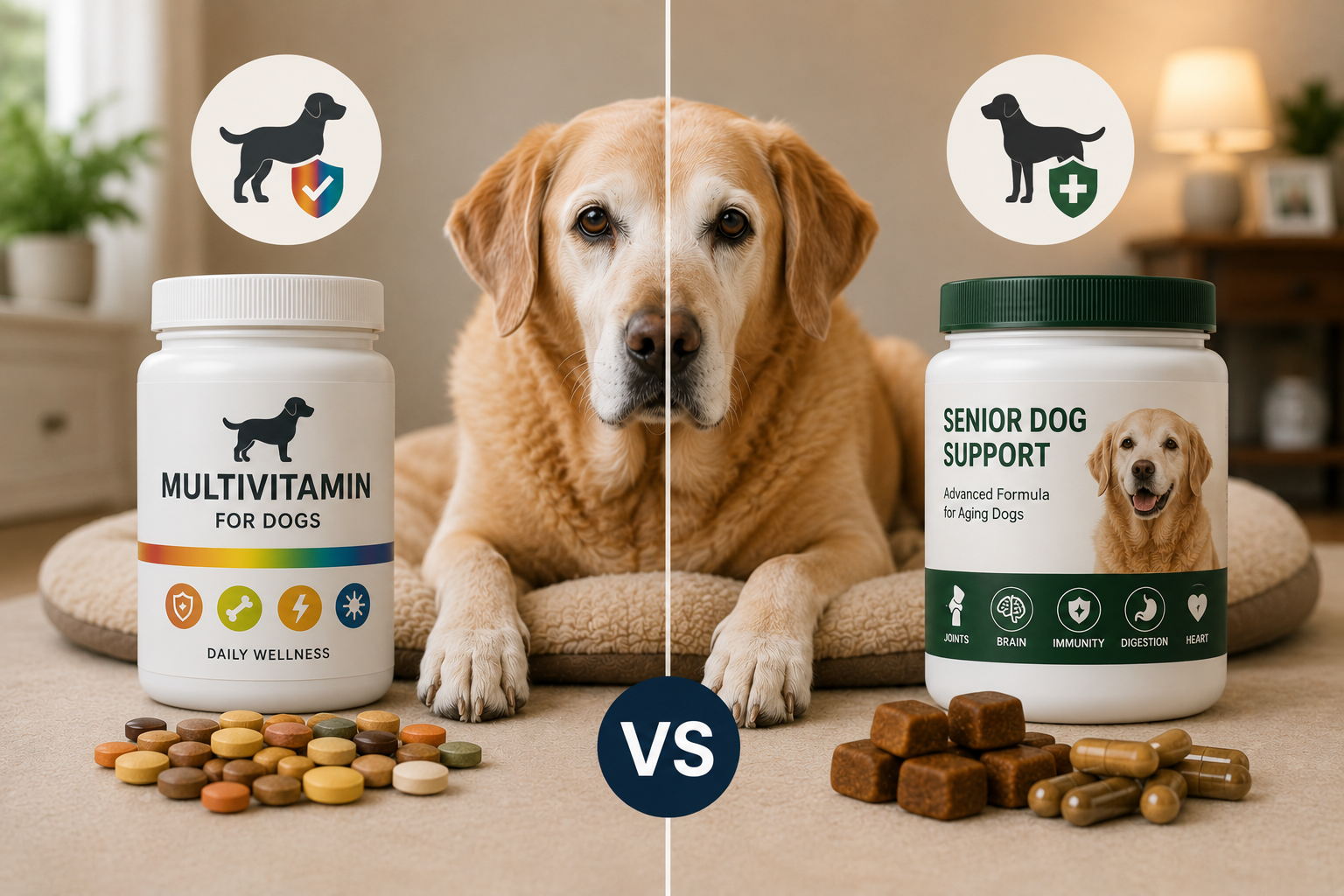
Multivitamin vs specific senior dog supplements is a genuine decision point, not simply a matter of picking whichever product has the most convincing packaging. As dogs age, energy levels shift, joints stiffen, digestion slows, and immune resilience weakens, and the right supplement approach depends on whether your dog needs broad, general support or something addressing one specific, active problem.
This guide covers when a multivitamin is the right call, when a targeted supplement serves your dog better, and when the two genuinely work well together rather than being an either-or choice. For which supplement categories matter for an ageing dog in the first place, our guide on what supplements senior dogs need covers that groundwork. For specific multivitamin products once you have decided that route fits, our best multivitamin for senior dogs guide covers the strongest options. For the natural versus synthetic dimension of either choice, our guide on natural vs synthetic dog supplements covers that separately.
This post may contain affiliate links. If you buy through these links, I may earn a small commission at no extra cost to you. As an Amazon Associate, I earn from qualifying purchases.
Table of Contents
Why Senior Dogs Need Extra Nutritional Support
As dogs age, several systems change at once in ways that a standard diet, however good, does not always fully address. Joint cartilage wears down faster than the body repairs it. Metabolism slows, changing how efficiently nutrients are absorbed from food. The immune system becomes less resilient, and digestion often becomes less consistent than it used to be.
A multivitamin addresses several of these changes broadly, in modest amounts, across many systems at once. A targeted supplement addresses one specific system, at a considerably higher, more clinically meaningful dose than a multivitamin would ever include for that single ingredient. Neither approach is inherently superior. The right one depends entirely on what your dog is actually dealing with.
When a Multivitamin Is the Right Choice
A multivitamin makes the most sense for a senior dog that is generally healthy, without one specific, dominant condition driving the need for supplementation. If your dog shows no obvious joint stiffness, no digestive irregularity, and no diagnosed condition, but you want to support overall immune function, coat condition, and general vitality as a preventive measure, a well-formulated multivitamin covers that ground efficiently in a single product.
A multivitamin is also a reasonable starting point for an owner new to supplementing a senior dog, since it introduces broad support without committing to a specific, higher-dose targeted product before it is clear which single area, if any, actually needs the extra attention.

When a Targeted Supplement Is the Right Choice
A targeted supplement is the better choice once your dog has a specific, identifiable problem that a multivitamin’s modest, broad-spectrum doses are not designed to address. A dog with diagnosed arthritis or visible joint stiffness needs glucosamine and chondroitin at a therapeutic dose, considerably higher than what any multivitamin includes as one ingredient among many. A dog with ongoing digestive irregularity needs a dedicated probiotic at a meaningful CFU count, not the token amount sometimes included in a general formula. A dog with anxiety or disrupted sleep may benefit from a specific calming supplement addressing that need directly.
The general rule is straightforward: the more specific and active the problem, the more a targeted supplement outperforms a multivitamin’s broad, modest coverage of the same ingredient.
When Both Together Makes the Most Sense
Many senior dogs genuinely benefit from a multivitamin and a targeted supplement running alongside each other, rather than choosing one exclusively. A multivitamin covers general nutritional gaps, coat, immunity, baseline vitality, while a targeted supplement addresses one specific, active concern such as diagnosed joint disease at a proper dose.
Before combining the two, check for ingredient overlap between them. A multivitamin containing a modest amount of glucosamine, combined with a full-dose dedicated joint supplement, is not usually dangerous, but it means part of what you are paying for in the multivitamin is being duplicated by the more concentrated product. Checking both labels together, rather than assuming they simply stack harmlessly, avoids wasting money on the same ingredient twice.
How to Decide for Your Specific Dog
Start by identifying whether your dog has one specific, active problem or is generally healthy without a dominant concern. A dog with no particular issue, wanting general preventive support, is well served by a multivitamin alone. A dog with a diagnosed condition or a clear, persistent symptom, stiffness, digestive irregularity, anxiety, needs a targeted supplement addressing that specifically, with or without a multivitamin alongside it.
Check the label of anything you are considering for disclosed ingredient amounts rather than a vague blend, and involve your vet if your dog is already on medication or has more than one condition to manage at once, since that is exactly the situation where checking for overlap and interaction matters most.
What Happens If You Choose the Wrong Approach
Choosing the wrong approach rarely causes serious harm on its own, but it does waste time, money, and, more importantly, the window in which addressing an actual problem would have made the most difference.
Giving a generally healthy senior dog only a broad multivitamin, when the real issue is diagnosed arthritis, means the joint disease continues progressing while the dog receives a dose of glucosamine too modest to meaningfully slow it. The multivitamin is not harmful, and it is not useless for the other systems it supports, but it is the wrong tool for the specific job in front of it. Weeks or months can pass with an owner assuming they are “doing something” for their dog’s joints, when the amount of active ingredient involved was never going to be enough to matter.
The reverse mistake, reaching immediately for a highly targeted, single-purpose supplement before confirming there is actually a specific problem to target, tends to be less harmful but still wasteful. A generally healthy senior dog does not need a therapeutic-dose joint formula if there is no joint issue present yet, and the money spent there could have gone toward a broader multivitamin covering several areas of genuine, if modest, benefit instead.
The practical lesson is to match the tool to the actual problem, rather than defaulting to whichever category sounds more serious or more premium. A modest, real need calls for a modest, broad approach. A specific, diagnosed need calls for a targeted, higher-dose product built for exactly that purpose.

How Your Vet Fits Into This Decision
A veterinarian is not simply a formality to check off before buying a supplement. For the multivitamin versus targeted supplement decision specifically, a vet visit can genuinely change which option makes sense, particularly for a dog whose symptoms are not entirely clear-cut.
A dog showing mild, occasional stiffness might reasonably be assumed to need a joint supplement, but a vet examination can confirm whether that stiffness is early arthritis, a soft-tissue issue, or simply a temporary result of reduced activity during a period of bad weather. Each of these points toward a different response, and only one of them clearly calls for a targeted joint formula at all.
A vet can also flag interactions or overlaps an owner would not necessarily catch alone, particularly for a dog already on medication for an unrelated condition. Certain herbal ingredients in targeted formulas, and even high-dose fish oil in some multivitamins, can interact with specific prescriptions in ways that are not obvious from reading a supplement label in isolation.
Bringing your dog’s current food label and any supplement you are considering to a routine check-up, rather than treating supplementation as a separate decision made entirely at the pet store, turns a five-minute conversation into meaningfully better information than guessing based on a product’s marketing copy alone. This matters more the more overlapping conditions or medications your dog is already managing, since that is exactly the situation where a generic online guide, including this one, has the least visibility into your specific dog’s actual situation.
FAQ
Can senior dogs take both a multivitamin and a targeted supplement?
Yes, and many senior dogs do well on exactly this combination. A multivitamin covers general nutritional gaps while a targeted supplement addresses one specific, active concern at a proper dose. Check both labels for ingredient overlap before combining them, so you are not unknowingly paying for the same nutrient twice.
Is a multivitamin enough for a senior dog?
For a generally healthy senior dog with no specific, diagnosed condition, a good multivitamin often provides sufficient broad support. A dog with arthritis, ongoing digestive issues, or anxiety typically needs a targeted supplement addressing that concern directly, since a multivitamin’s dose of any single ingredient is modest by design.
How do I know which approach my dog actually needs?
Look at whether your dog has one specific, observable problem or is generally healthy without a dominant concern. Stiffness after resting points toward a targeted joint supplement. Ongoing loose stools point toward a dedicated probiotic. No specific issue at all points toward a multivitamin as a reasonable, broad starting point.
What is the best age to start senior dog supplements?
Many dogs benefit from starting around age seven, though large and giant breeds often benefit earlier, from five or six, given their generally faster ageing process. The more reliable trigger is the appearance of an actual sign, stiffness, reduced energy, digestive irregularity, rather than age alone.
Can combining supplements cause side effects?
It can, particularly with fat-soluble vitamins such as A, D, and E, which can accumulate across multiple overlapping products if nobody checks the combined total. Start one product at a time, follow the recommended doses, and check with your vet if your dog takes other medication.
Final Thoughts
Multivitamin vs specific senior dog supplements is not a question with one universal answer. A generally healthy senior dog without a dominant concern is well served by a good multivitamin alone. A dog with a specific, active problem needs a targeted supplement addressing that directly, at a dose a multivitamin was never designed to provide. Many senior dogs benefit from both together, provided the labels are checked for overlap first.
Identify what your dog actually needs before choosing a product, rather than assuming broader coverage is automatically better or that a targeted formula is automatically necessary.
Sources
- https://www.ncbi.nlm.nih.gov/pmc/articles/PMC8672265/
- https://www.ncbi.nlm.nih.gov/pmc/articles/PMC8849458/
- https://www.vet.cornell.edu/departments-centers-and-institutes/riney-canine-health-center/canine-health-topics/how-joint-supplements-can-help-orthopedic-conditions
- https://europeanpetfood.org/wp-content/uploads/2022/03/FEDIAF_SAB_Statement_Nutrition_of_Senior_Dogs_fin.pdf



Pingback: Best Multivitamin For Senior Dogs + Top Picks 2026
Pingback: Best Supplements For Senior Dogs - seniordog-care